
Air Handlers
The blower and coil that move every cubic foot of air in a split system.
Cooling Services
Whole-home comfort depends on the equipment, the ductwork and the way air moves between rooms. We look at all three when we evaluate a central air system.
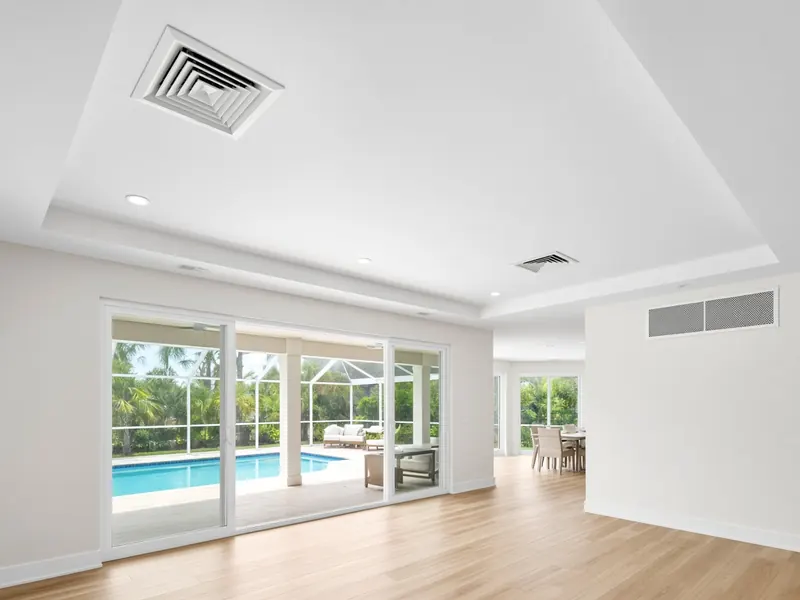
Central air conditioning cools every room from one system, moving conditioned air through a network of supply ducts and pulling it back through returns. It is the most common way Ocala homes are cooled, and Ventis services, evaluates and installs central systems throughout Marion County.
This page is about the system as a whole: how the pieces fit together, why two houses with similar equipment can feel completely different and what shapes comfort from room to room. For a specific failure, the AC repair page is the better starting point. For a purchase decision, see AC installation and replacement.
A central air conditioner moves heat from inside the house to the outdoors using refrigerant. Indoors, a blower pulls room air across a cold evaporator coil, where the refrigerant absorbs heat and moisture condenses. Outdoors, a compressor pumps that refrigerant to the condenser coil, where a fan releases the heat. Ducts carry the cooled air to each room.
The refrigeration cycle repeats continuously while the system runs:
Low-pressure liquid refrigerant boils in the indoor coil and absorbs heat from the air passing over it.
The compressor raises the pressure and temperature of the refrigerant vapor.
In the outdoor coil, the hot vapor gives up its heat to outside air and condenses back to liquid.
A metering device drops the pressure so the refrigerant can absorb heat again indoors.
A split system divides the equipment between two locations. The outdoor condensing unit holds the compressor, condenser coil and fan. The indoor section holds the evaporator coil and blower, either in a dedicated air handler or on top of a furnace. Copper refrigerant lines and low-voltage control wiring connect the two.
In Ocala, the indoor section is usually found in a hall closet, garage or attic. Each location has tradeoffs. An attic unit saves floor space but sits in the hottest part of the house and puts a drain pan above finished ceilings. A closet unit is easier to service but needs a proper return path and enough room for filter access. Indoor-unit issues are covered on our air handler services page.
A packaged unit combines every major cooling component, including the compressor, the indoor and outdoor coils and the blower, in one outdoor cabinet, usually on a pad beside the house or on a roof. Supply and return ducts pass through the wall or floor to reach the living space. Packaged systems are common on manufactured homes and on houses without interior room for an air handler.
On a manufactured home, the packaged unit usually connects to a duct trunk that runs under the floor. The connection between the unit and the home, often a flexible duct, is exposed to sun, weather and the occasional curious animal. Inspecting that connection and the skirting around it is part of servicing a packaged system properly.
The ducts are half of a central system. Supply ducts deliver cooled air to each room, and returns bring room air back to the equipment. In many Central Florida homes, most of that ductwork runs through the attic, where summer temperatures are far higher than outdoors.
The Department of Energy’s Building America Solution Center reports that losses related to duct systems can account for more than 30 percent of heating and cooling energy use when ducts are located in unconditioned space. Leaks at boots, plenums and flex duct connections, along with crushed or kinked runs, waste capacity before it reaches a room. Sealing, repairing and properly supporting ducts is often one of the most useful improvements a central system can get.
Many older homes were built with a single central return in the hallway. When bedroom doors close, those rooms can pressurize, supply air struggles to get in and the hallway pulls air from wherever it can, including wall cavities and the attic. Transfer grilles, jumper ducts or added returns give that air a path back to the equipment. An undersized return also forces the blower to work harder and can make filter grilles noisy.
Comfort in each room depends on getting the right volume of air there, measured in cubic feet per minute. Airflow is shaped by duct size, length and fittings, register placement and the blower setting. Too little air to a bedroom and it stays warm. Too much air across the coil overall and humidity removal suffers.
Technicians evaluate airflow by measuring total external static pressure, which shows how much resistance the blower faces, and by checking temperatures at supply registers. Closing vents in unused rooms rarely helps: it raises static pressure and can reduce airflow across the coil without saving much energy.
A room that never cools usually has a duct problem, a heavy solar load or both. Common causes include a long or crushed supply run, a disconnected duct in the attic, no return path when the door is closed, or large west-facing windows. Bonus rooms over garages are frequent offenders. Measuring the airflow to that room is the starting point for a fix.
A central air conditioner dehumidifies as a side effect of cooling. Moisture condenses on the cold evaporator coil and drains away. How much it removes depends on how long the system runs, how cold the coil gets and how fast air moves across it.
The EPA recommends keeping indoor humidity below 60 percent to limit mold growth. If your home feels sticky at a normal set point, possible causes include an oversized system, high blower airflow, a fan left in the On position, duct leaks pulling in humid attic air or a refrigerant problem. Variable-speed equipment and, in some homes, a whole-home dehumidifier can improve control when the basics are already right.
Duct sizing, leaks or missing returns leave some rooms several degrees off the thermostat.
Short run times, excess airflow or attic air leaking into return ducts can keep humidity high.
Whistling or rushing air usually points to undersized returns or high static pressure.
Duct losses, a dirty coil or undersized equipment can keep the system running through hot afternoons.
Federal rules set minimum ratings for central systems installed in Florida. A split air conditioner smaller than 45,000 Btu/h needs at least 14.3 SEER2; at that size and above, the minimum is 13.8 SEER2. Ratings are only part of the story. A system’s real-world efficiency also depends on duct leakage and insulation, airflow, refrigerant charge, coil cleanliness and thermostat habits.
Before spending extra on a higher-rated unit, it is worth checking whether duct repairs or sealing would deliver a larger improvement for the money. Ongoing seasonal AC tune-ups keep coils and airflow close to their original condition.
The right central system depends on your home’s calculated load, the condition and location of the ductwork, where the equipment can go and how you want humidity handled. Homes with no ducts, or a single room the ducts cannot reach, may be better served by a ductless mini-split system for that space.
For homes being built, central system design starts long before equipment arrives. Our new construction HVAC page explains how load calculations and duct design are coordinated with the build.
Ventis works on the whole central system, not just the box outside. Services include performance evaluations, airflow and static pressure testing, duct inspection and repair, humidity troubleshooting, equipment repair and replacement, and maintenance for split systems and packaged units. If your home has comfort problems that repairs have not solved, a whole-system evaluation is a good place to start.
Related Services
The blower and coil that move every cubic foot of air in a split system.
Load-calculated equipment for homes ready for a new central system.
Coil cleaning, drain care and performance checks each season.
Diagnosis for systems that stop cooling or start leaking.
Service Areas
Whole-home systems in Marion County share the same climate but not the same houses. We evaluate central air in neighborhoods such as:
FAQ
Central air describes how cooling is delivered: one system serving the whole house through ducts. A heat pump is a type of equipment that can provide that central cooling and also run in reverse to heat. A cooling-only central air conditioner relies on a separate heat source, such as electric heat strips or a furnace, for winter.
For humidity control in a Florida summer, Auto is usually the better setting. With the fan set to On, the blower keeps running after the compressor stops, and water on the wet coil can evaporate back into the house. Some variable-speed systems manage continuous fan operation differently, so check with your technician about your specific equipment.
Usually not. Central systems are designed to move a set amount of air. Closing several supply registers increases duct pressure, can push more air out through duct leaks and may reduce airflow across the indoor coil, which can lead to icing. Keeping registers open and fixing the underlying airflow problem is the more reliable approach.
Signs include rooms that never cool, dust streaks around registers, high humidity, a dusty attic near duct joints and higher-than-expected bills. A visual attic inspection can find disconnected or torn ducts. Measuring static pressure and room airflow, or a duct leakage test, gives a more complete picture of how much air is being lost.
It depends on the house. Packaged units suit homes without indoor space for an air handler, including many manufactured homes, and keep service work outdoors. Split systems offer more equipment combinations and keep the blower indoors. If your home already has one type, replacing like for like is often the simplest path, but it is worth discussing.
A correctly sized, well-installed central system handles humidity well in most homes. Problems tend to appear when equipment is oversized, airflow is set too high, ducts leak attic air into returns or the home is very tight with low cooling loads. In those cases, variable-speed equipment or a dedicated whole-home dehumidifier can help.
Yes, but it requires designing and installing a full duct system, which depends on attic or crawlspace access and the home’s layout. For older homes or homes where duct runs would be difficult, a ductless mini-split system is often a practical alternative. A site visit is needed to compare the two approaches.
Whistling usually means air is moving through a restriction at high velocity. Common causes include an undersized return, a clogged or overly restrictive filter, closed registers or dampers, and undersized supply ducts. Measuring static pressure helps confirm the cause. Correcting it can make the system quieter and improve airflow across the coil.
Uneven rooms, sticky air or rising bills? Schedule a central air evaluation and we’ll look at the equipment, the ducts and the airflow together.
(352) 230‑9545