
AC Repair
Diagnosis and repair for systems that are not cooling, leaking or shutting down.
Cooling Services
Repairs, replacements, tune-ups and new-home installations for central air, heat pumps, air handlers and ductless systems, with clear explanations at every step.

Ventis Heating and Air Conditioning provides residential cooling services for homeowners in Ocala and the surrounding Marion County communities. That covers the full life of a system: the first installation, routine care, repairs when something fails, and the eventual replacement decision.
Most people call an HVAC company for one of three reasons. The house is not cooling, the equipment is getting old, or a new home is going up. Each situation calls for a different kind of visit, and this page explains what those visits involve so you can pick the right starting point.
If you already know what you need, the service list below links to a detailed page for each one. If you are not sure, call (352) 230‑9545 and describe what you are noticing. We will help you sort out whether it sounds like a repair, a maintenance issue or a bigger conversation about equipment.
A Central Florida air conditioner has two jobs at once: lowering the air temperature and pulling moisture out of the air. In Marion County the cooling season starts early and ends late, so the equipment logs far more operating hours each year than a system in a northern state.
Those long hours show up in a few predictable places:
None of this means Florida equipment is doomed to fail early. It does mean that design, installation quality and regular attention matter more here than in a milder climate.
Each service below has its own page with technical detail, common questions and what to expect. Here is a short summary of where each one fits.
Repair visits are for systems that have stopped cooling, are leaking water, are making new noises or keep tripping a breaker. A technician tests the electrical parts, refrigerant circuit, airflow and drainage to find the cause before replacing anything. Our AC repair service page walks through common failures and the diagnostic process.
When a system is aging, unreliable or simply mismatched to the house, replacement becomes a design decision rather than a parts swap. Equipment size should come from a room-by-room load calculation, and efficiency choices should fit how you use the home. Read about air conditioner replacement and installation before you collect estimates.
A tune-up is a planned visit for a system that is working. The technician cleans, measures and adjusts so small problems are found while they are still small. The AC maintenance and tune-up page lists what a thorough visit covers and how often Florida systems should be serviced.
Central air is the ducted, whole-home system most Ocala houses rely on, either as a split system with indoor and outdoor sections or as a single packaged unit. Comfort depends on the equipment and the ducts working together. Learn how whole-home systems are configured on our central air conditioning services page.
The air handler is the indoor cabinet with the blower, evaporator coil and condensate pan. Weak airflow, water leaks and musty odors often start here. See air handler repair and installation for blower, coil and drainage problems and replacement considerations.
Mini-splits cool individual rooms or zones without ductwork. They suit additions, enclosed porches, garages and homes that never had ducts, though they are not the right answer for every house. Our ductless mini-split services page covers the benefits and the limits.
For builders, general contractors and owners building a custom home, HVAC work begins at the plan stage with load calculations, equipment selection and duct design. The new construction HVAC installation page explains how mechanical work fits into the construction schedule.
If the system is not cooling, leaking or making unusual noise, you need a repair visit. If it works but has not been serviced in the past year, schedule maintenance. If it is older and breaking down more often, ask for a replacement evaluation. Building or adding space calls for a design conversation.
A thermostat reading of 76°F can feel pleasant or muggy depending on the moisture in the air. The U.S. Environmental Protection Agency recommends keeping indoor relative humidity below 60 percent, ideally between 30 and 50 percent, to discourage mold growth. In a humid climate, that target depends heavily on how the air conditioner is sized and set up.
An oversized system cools the air quickly, satisfies the thermostat and shuts off before the coil has run long enough to remove much moisture. The result is a home that hits the set temperature but still feels damp. Running the blower continuously in the “On” position can also return moisture from a wet coil back into the house. Proper sizing, correct airflow and, in some homes, variable-speed equipment or a dedicated dehumidifier help solve this.
Efficiency starts with the rating on the equipment, but it does not end there. Duct leakage, dirty coils, restricted filters and incorrect refrigerant charge can all cause a high-efficiency system to perform like a much older one.
Florida is in the U.S. Department of Energy’s Southeast region. Split-system central air conditioners installed here since January 1, 2023 must be rated at least 14.3 SEER2 below 45,000 Btu/h of capacity and at least 13.8 SEER2 at or above it. Split-system heat pumps carry a nationwide floor of 14.3 SEER2 for cooling and 7.5 HSPF2 for heating.
Higher ratings can lower operating costs, but the savings for any one home depend on its size, insulation, ductwork, thermostat habits and electric rates. We prefer to show you how those factors apply to your house rather than promise a percentage.
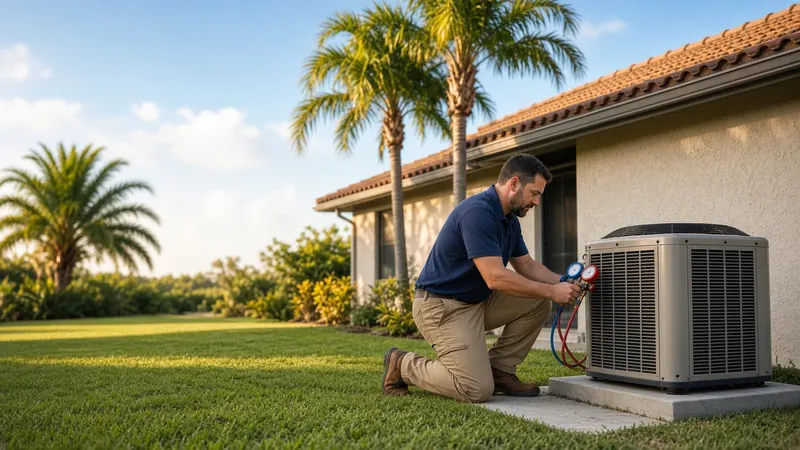
The right contractor is the one who explains what they found, documents it and gives you options. A few questions help separate a careful company from a rushed one:
Call or request service online. Mention the system type if you know it, the age of the equipment and when the problem started.
A technician inspects the indoor and outdoor equipment, takes measurements and looks at the ductwork and drainage that affect performance.
You get an explanation of the findings and the options, including when a repair is the sensible choice and when it is not.
Work starts only after you agree to it. The system is then tested through a full cycle before the technician leaves.
Where to Start
Diagnosis and repair for systems that are not cooling, leaking or shutting down.
Scheduled cleaning, testing and adjustment for a system that is still running.
Load-calculated equipment selection and installation for aging systems.
Room-by-room cooling for additions and spaces without ductwork.
Service Areas
Ventis serves homeowners in Ocala, Silver Springs, Belleview, Summerfield, Dunnellon and neighborhoods across Marion County, including:
FAQ
Ventis provides residential air conditioning repair, replacement and installation, preventive maintenance, central air conditioning service, air handler repair and replacement, ductless mini-split service and new construction HVAC installation. Service covers Ocala and the surrounding Marion County communities. Each service has its own page with details on what the work involves.
Yes. In cooling mode a heat pump works the same way as a central air conditioner, so cooling-side problems such as drainage, airflow, electrical and refrigerant issues are diagnosed in much the same way. A heat pump also has a reversing valve and defrost controls for winter heating, which are checked when the system is serviced.
Cost depends on the service. Repairs vary with the failed part and how accessible the equipment is. Replacement depends on system type, capacity, efficiency, ductwork condition and installation requirements. Maintenance pricing depends on the visit or plan. You receive an explanation of the work and its cost before any job begins.
The EPA recommends keeping indoor relative humidity below 60 percent, ideally between 30 and 50 percent. A small digital hygrometer from a hardware store will tell you where your home sits. If readings stay high while the air conditioner runs, the cause may be equipment size, airflow settings or duct leakage, and a technician can check each one.
For split-system central air conditioners installed in Florida, the federal minimum is 14.3 SEER2 for units under 45,000 Btu/h and 13.8 SEER2 for larger units. Split-system heat pumps must meet 14.3 SEER2 and 7.5 HSPF2. Many models exceed these minimums, and the best choice depends on your home and budget.
Usually, yes. Replacing or installing central heating and cooling equipment typically requires a permit and inspection from the building department that covers your address, which is either Marion County or the City of Ocala. The contractor normally applies for it. Ask who is responsible for the permit before you sign an agreement.
Yes. The skills overlap, but the work is planned differently. Service calls focus on diagnosing an existing system. New construction starts with plans, load calculations, equipment selection and duct design, then rough-in and startup. Ventis supports homeowners, builders and general contractors, so tell us which type of project you have when you call.
Look for an indoor cabinet in a closet, garage or attic. If you have one plus an outdoor condenser connected by copper refrigerant lines, it is a split system. If all the equipment sits in one outdoor cabinet with ducts running into the house, it is a packaged unit. Both are forms of central air conditioning.
Your address, the symptoms you have noticed and when they started are the most useful details. If you can, read the model number and refrigerant type from the nameplate on the outdoor unit. Let us know about recent storms, power outages or water near the indoor unit, since those details help narrow the cause.
Not sure whether you need a repair, a tune-up or a new system? Call or schedule a visit and we’ll help you figure out the next step.
(352) 230‑9545