Buying a Home in Ocala? An HVAC Checklist for Your Inspection Period
If you are buying a house anywhere from the Golden Ocala area out to Silver Springs Shores, you will hear the same advice from agents and lenders: get a home inspection. That is good advice. But a general home inspection covers the whole house in a few hours, and in Central Florida the heating and cooling system deserves a closer look than a general walkthrough can usually give it.
Your air conditioner runs most of the year here. It controls humidity as well as temperature, and when it fails in August, you find out fast. Knowing its true condition before closing gives you room to negotiate, plan a budget, or walk away. Here is the checklist we would want in hand if we were buying a home in Marion County.
How old is the HVAC system in the house?
The age of the system is the first thing to pin down, and the data plate is where you find it. Both the outdoor unit and the indoor air handler have a manufacturer’s label with a model and serial number. Many manufacturers encode the build date in the serial number, and a technician can decode it in a minute. Check both units. It is common to find a newer outdoor condenser paired with an older air handler, or the other way around, after a partial replacement.
Do not rely on the listing description alone. “AC replaced recently” can mean many things. Get the actual dates.
Does the system still use R-22 refrigerant?
Check the refrigerant type printed on the outdoor unit’s nameplate. The EPA notes that most air conditioners have a nameplate identifying the refrigerant they contain. If it says R-22 or HCFC-22, you are looking at an older system.
According to the EPA, U.S. production and import of HCFC-22 ended on January 1, 2020. Owners can keep using an existing R-22 system as long as necessary, serviced with refrigerant that was recovered and reclaimed or produced before 2020. That supply is limited, so a refrigerant leak on an R-22 system is often the moment a repair turns into a replacement conversation. An R-22 unit in a home you are buying is not a deal breaker, but it belongs in your budget and your negotiations.
Were the HVAC changes permitted?
Ask for proof that any replacement was permitted and inspected, then check it yourself. In Marion County, the county’s Civic Access public record search covers building safety permits. Inside the Ocala city limits, the City of Ocala’s eTRAKiT portal lets the public search properties and view permitting details. An Ocala mailing address does not always mean the property is inside the city, so check which jurisdiction covers the parcel before you search.
A replacement with no permit on file raises questions. Was the work done by a licensed contractor? Was the equipment sized and installed to code? Was the wind anchorage done right? Missing permits can sometimes be resolved, but you want to know before closing, not after.
What should I look at outside?
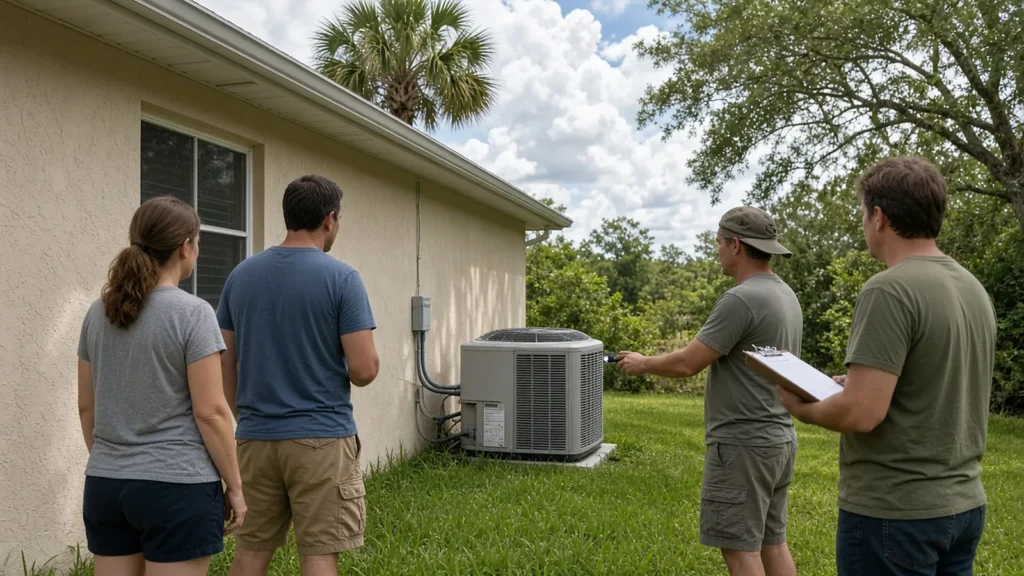
Walk around the outdoor unit with the system running and look for these:
- Coil condition. Fins packed with grass clippings, dog hair or rust, or flattened by a weed trimmer, cut airflow.
- A level pad. Sandy soil around Ocala can wash out from under a pad. A tilted unit strains its refrigerant lines.
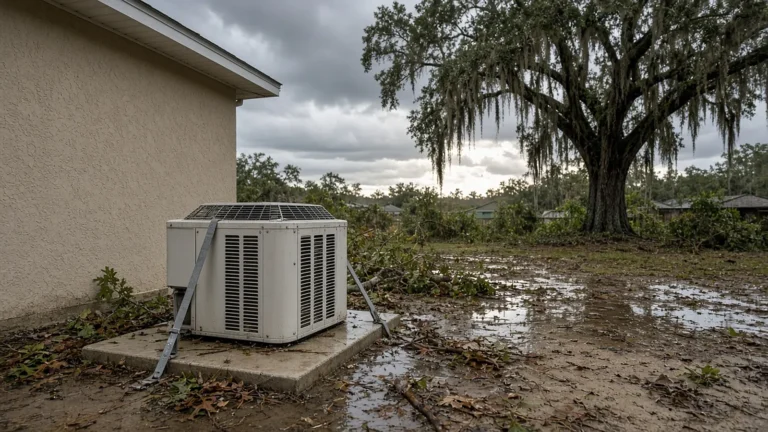
- Tie-downs. Florida code requires fixed appliances to be anchored. Look for straps or brackets.
- Refrigerant line insulation. The larger copper line should be wrapped in foam insulation that is intact, not cracked or missing in the sun.
- Electrical. The disconnect box should be secured, with a cover, and the flexible conduit to the unit intact.
- Noise. Rattling, grinding or a loud hum at startup is worth noting.
What should I check inside the house?
The indoor side tells you more about how the system has been cared for. Ask to see:
- The air handler and its location. Closets, garages and attics each have their own issues. An attic unit needs a secondary pan and a working safety switch, because an overflow there lands on your ceiling.
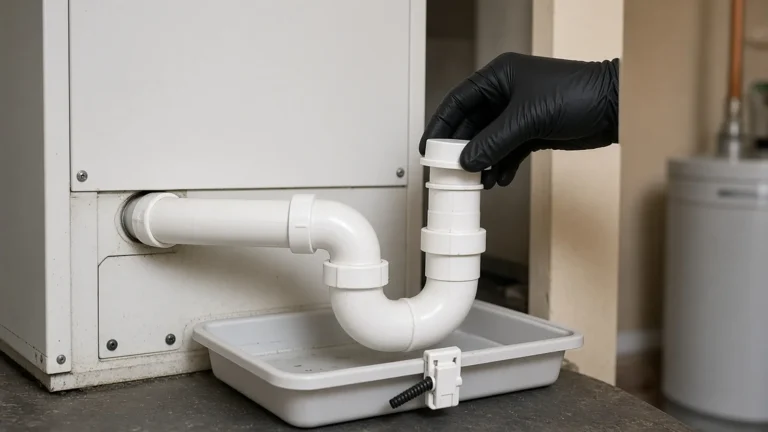
- The condensate drain. Look for water stains, rust in the pan or a missing float switch. Our condensate drain guide shows what a proper setup looks like.
- The filter. A filled-in, gray filter tells you how often it was changed. A filter slot with gaps around the edges means dirt has been reaching the coil.
- Ductwork in the attic. Crushed, disconnected or sagging flexible duct is common in older Ocala homes. Leaky ducts pull hot, humid attic air into the system.
- Registers and returns. Feel for airflow in every room, including bonus rooms and additions, which are sometimes tied into a system never sized for them.
How can I tell if the AC is working properly?
The simplest homeowner test is comfort and humidity. During a showing on a hot day, notice whether the house feels cool and dry or cool and clammy. A musty smell can point to drain or duct moisture problems.
A technician can go further. A full evaluation includes measuring the temperature drop across the indoor coil, checking refrigerant pressures, testing capacitors and the blower motor, checking electric heat strip operation, and running the heat pump in heating mode if the house has one. If you are buying in summer, ask that heating be tested anyway. In a Central Florida January, you will want to know the strips and the reversing valve work.
Ask about past problems too. A system that needed several refrigerant top-offs is probably leaking.
Which findings should change my offer?
Some findings are small and normal for a used house. Others deserve a repair request, a credit or a second look at the deal. These are the ones that tend to matter most:
- An R-22 system with a leak history. Refrigerant top-offs on an older system usually lead to replacement sooner rather than later.
- An attic air handler with no secondary protection. No auxiliary pan, no float switch, or a pan full of rust is a ceiling waiting to fail.
- Water stains below the air handler. Stains on a ceiling under the attic unit or rot in a closet floor point to drain trouble that may have gone on for a while.
- Disconnected or crushed ducts. Air dumping into the attic means the system has been working harder than it should, and repairs can be extensive in tight attics.
- Mismatched or patched equipment. A new outdoor unit tied to an old indoor coil may not deliver its rated efficiency, and warranty terms may be affected.
- Visible mold growth on registers or inside the air handler. That points to a moisture problem that a filter change will not solve.
- Unpermitted replacement. Ask the seller to resolve it or factor the uncertainty into your price.
None of these automatically kills a deal. They simply give you facts to bring back to the negotiating table, and they are much easier to address now than after closing.
What documents should I ask the seller for?
Request what the seller has, in writing:
- Installation invoice and date, with contractor name
- Permit number or final inspection record
- Manufacturer warranty registration, if the system is newer
- Maintenance records or a service agreement
- Any repair invoices from the last few years
You can verify a Florida contractor’s license through the Department of Business and Professional Regulation, which lets users verify licenses by name or license number.
How do I fit an HVAC evaluation into my inspection period?
Schedule it early. Inspection periods move fast, and if the general inspector flags the HVAC system for further evaluation, you want time left to get a specialist out, get an estimate and negotiate. Ask the seller’s side for access to the attic and the air handler closet, and to have the system on and the filter in place.
If you are buying in Ocala or anywhere in Marion County and want a pre-purchase HVAC evaluation, send us a message with the address and your inspection deadline. If the system turns out to be near the end of its run, our AC installation page explains how replacement is planned and priced, and our maintenance program can keep a newer system in good shape after you move in. For more on the area, see our Ocala service area page.
Frequently asked questions
Does a general home inspection test the air conditioner in detail?
General home inspectors typically confirm that the system runs and note visible problems. Refrigerant pressures, electrical component tests and duct leakage are usually beyond the scope of a general inspection, which is why many buyers add an HVAC evaluation.
Should I ask the seller to replace an old system before closing?
You can, but you usually get less say in the equipment and installer that way. Many buyers prefer a price credit so they can choose the system and contractor themselves after closing.
Is a home warranty a substitute for an HVAC evaluation?
No. Home warranties often have limits, exclusions and service fees, and they do not tell you the condition of the system before you buy. Read the contract terms closely.
What if the home has two air conditioning systems?
Treat them as two separate purchases. Check the age, refrigerant, permit record, drain setup and filter for each one, since it is common for one system to have been replaced and the other left alone.
Sources